

A remarkable archaeological discovery has prompted scientists to fundamentally re-evaluate their understanding of the harshness of the Ice Age and has revealed a deeply hidden emotional aspect of our earliest ancestors’ lives.
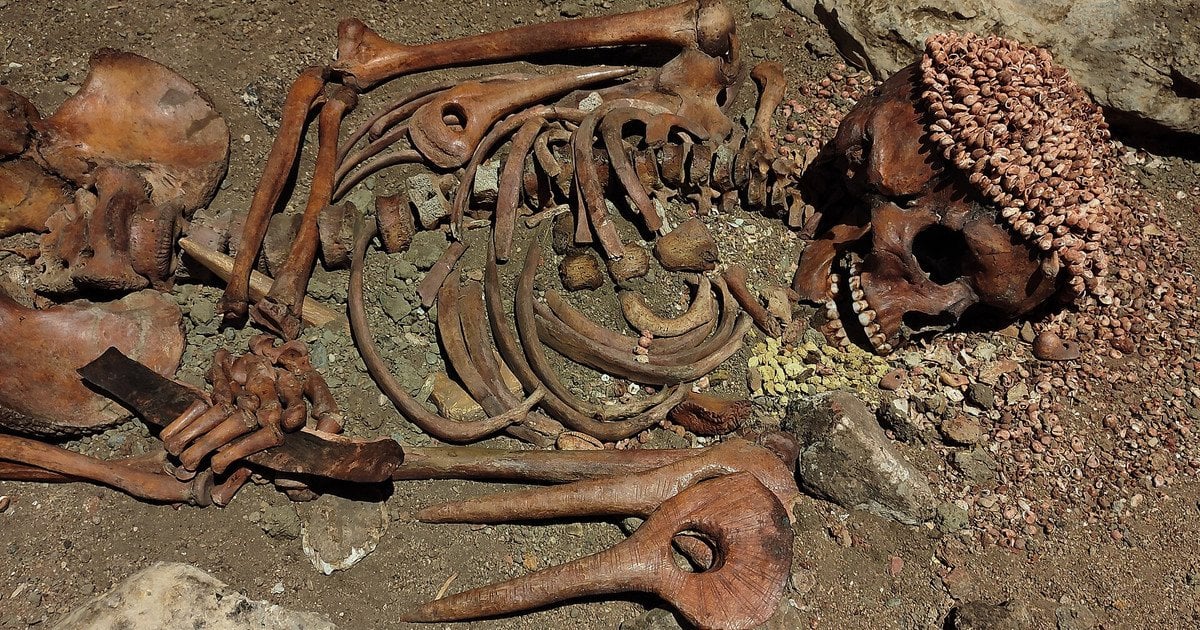
Remains of “Prince Areni Candidus” in the Archaeological Museum of Peille, Italy. Photo: Lorenzo Donzelli / © wikimedia.org
Approximately 27,500 years ago, in the region of modern-day Italian Liguria, within the Areni Candide cave [meaning “Cave of White Sands” in Italian — ed.], a Paleolithic community tenderly buried a 15-year-old adolescent who had sustained fatal injuries, likely from a bear attack. To preserve his memory, they performed an elaborate burial ritual that challenges the prevailing notion of a brutal and isolated existence during the Ice Age.
This unique archaeological find, shedding light on the emotional lives of ancient communities and their attitudes toward death, is reported by The Conversation.
Care for the Living and the Deceased
Scientists have determined that the community transported the adolescent to the cave despite the mortal injuries to his jaw, neck, and left shoulder, and stayed with him for several days until his passing. To alleviate his suffering, they used red ochre as a medicinal agent.
“The use of the same pigment for healing and burial reveals a new facet of prehistoric life, demonstrating how deeply these early communities valued care and reverence for their deceased,” notes the archaeologist.
The community not only attempted to save the teenager’s life but also buried him with profound respect. His remains, covered in red ochre, were adorned with hundreds of perforated seashells and deer canines that formed a headdress around his head, pendants made from mammoth ivory, and four decorated poles fashioned from elk antler. In his right hand, he still clutched a flint blade.

Reconstruction of a Paleolithic burial rite / AI
Remembrance and Rituals of Grief
The discoveries at Areni Candide prove that this cave served as a dedicated burial site, utilized for over 15,000 years. Here, archaeologists have unearthed other instances of burials involving intricate rituals. For example, in one of the later burials, over 29 ochre-dyed pebble halves were found, likely used as pigment applicators during funeral rites.
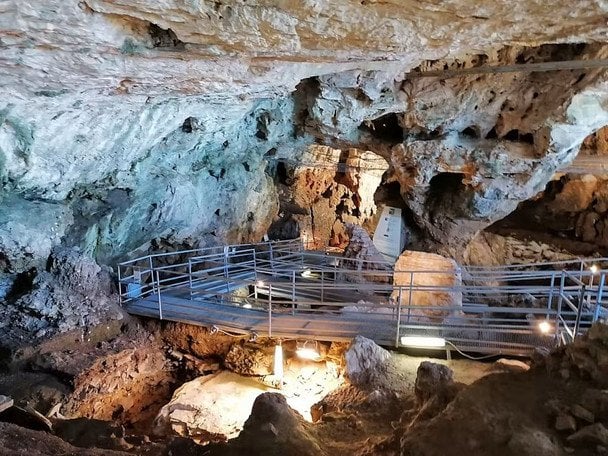
The Areni Candide cave in Finale Ligure, Italy, was a special burial site for thousands of years / © wikimedia.org
Archaeologists have established that these pebbles were intentionally broken in half: one part was left with the deceased, while the other was never recovered. This suggests that the community kept the halves as a memento of the departed, providing further evidence of enduring bonds extending beyond death.
These burials indicate that humans have long found ways to acknowledge the reality of death and maintain connections thereafter. Shared rituals of mourning united the community. Our capacity to use symbolic materials to navigate complex emotions dates back at least 27,500 years.
As a reminder, in Slovakia, near the town of Vráble, archaeologists discovered one of the most enigmatic and chilling burials in European history. In a mass grave dating back approximately 7,000 years, the remains of 77 individuals were found, entirely lacking skulls.
Comments Sort: New Old Popular Send
Source: tsn.ua